
What is IB Diploma
Simple Guide for Parents & Students
If your child is studying in an international school, you may have heard about the IB Diploma Programme — but what does it actually mean?
This guide explains it in a simple and practical way.

The IB (International Baccalaureate) Diploma Programme is a two-year academic program for students aged 16 to 19.
Established in 1968, the International Baccalaureate® (IB) Diploma Programme (DP) is recognized by universities around the world and, like national curricula, allows students to apply to higher education both locally and internationally.
The program was designed to provide a balanced and rigorous education, combining different subjects with skills such as writing, research, and critical thinking.
Students study a range of subjects and are assessed through a combination of final exams and coursework completed during the two years.
Beyond academics, the IB was created to support international mobility and global understanding.
It is widely used in international schools and is particularly suited for students who may study in different countries or plan to apply to universities abroad.
💡 The IB is not just about exams.
It develops independent thinking, writing, and global skills.
What Do Students Study in the IB Diploma?
The IB Diploma is different from most national systems because students do many subjects at the same time, instead of focusing on just a few.
➡️ In simple terms, over 2 years students study:
- 6 subjects at once
- Plus 3 additional core components
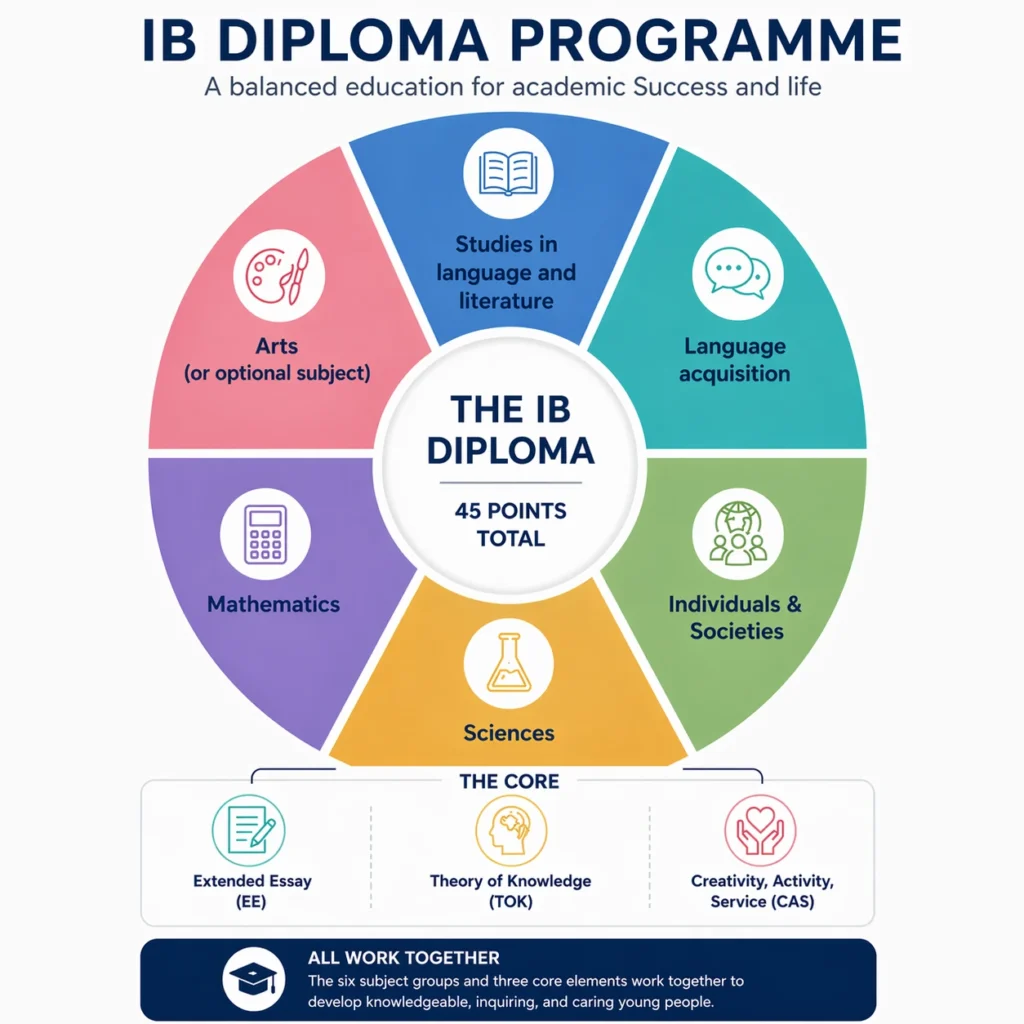
The 6 subjects
Students must choose one subject from each group, ensuring a balanced education.
Students do not study all subjects at the same depth.
- 3–4 subjects at Higher Level (HL) → more advanced, more hours
- 2–3 subjects at Standard Level (SL) → less depth
HL subjects require more content and deeper understanding
The 3 core components
These core components are mandatory and studied alongside the subjects throughout the two years.
These core components are mandatory and studied alongside the subjects throughout the two years.
How students are graded – the IB scores
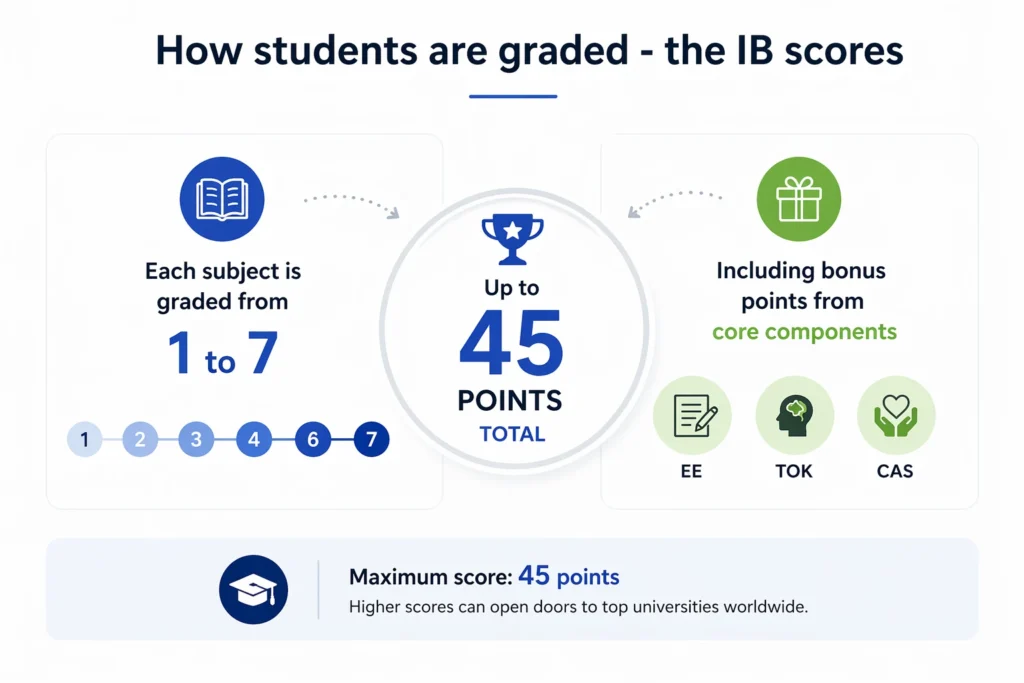
Each subject is graded from 1 to 7.
Students can earn up to 45 points total, including bonus points from core components.
Universities often look at predicted and final IB scores for admission.
👉 Strong IB scores can open doors to top universities worldwide.
What makes IB different from National Systems
Traditional Systems
- Students follow a fixed curriculum
- All students study the same subjects
- Learning is often more focused on:
- content
- memorization
- final exams
- There is usually:
- less independent research
- fewer long written projects
- less flexibility in subject choice
IB Diploma Programme
- Students choose their subjects
- They study a broad range (6 subjects at once)
- They complete:
- essays
- research projects
- continuous coursework
- The focus is on:
- understanding concepts
- writing and analysis
- independent thinking
Why students struggle
Why the IB Can Be Challenging
Many students are not prepared for this level of independence.
Where Academic Support Makes a Difference
Because of its structure, the IB often requires support beyond regular school classes.
Students benefit from help with:
- understanding complex subjects
- structuring written work
- preparing for exams
- managing workload
University
Does the IB Help with University Admissions?
The IB Diploma is recognized by universities in more than 100 countries and is widely accepted by leading institutions around the world.
However, the IB does not guarantee admission. Universities evaluate applicants based on their IB scores, course requirements, application materials, and overall academic profile.
Many universities value the IB because it develops skills such as critical thinking, research, academic writing, and independent learning. As a result, strong IB results can significantly strengthen a university application
Which Universities Accept the IB?
The IB Diploma is recognized by thousands of universities worldwide, including institutions in:
- United States
- Canada
- United Kingdom
- Europe
- Australia
- Latin America
Many highly selective universities regularly admit students with IB qualifications and are familiar with the rigor of the Diploma Programme.
Students should always check the specific admission requirements of each university and course.
Frequently Asked Questions
Is the IB harder than other school systems?
The IB is generally considered academically demanding because students balance multiple subjects, coursework, research projects, and final exams simultaneously.
What is a good IB score?
Scores above 30 are generally considered good. Scores above 35 are competitive, while scores above 40 are often associated with highly selective university applications.
Can the IB help with university admissions?
Yes. The IB is recognized internationally and is valued by many universities because of its academic rigor and emphasis on independent learning.
Do students need tutoring in the IB?
Many students seek additional support for challenging subjects, exam preparation, Internal Assessments, Theory of Knowledge, and the Extended Essay.
Need Help Navigating the IB?
We help IB students understand the program, improve their performance, and achieve their academic goals.